Your laptop stores a photo, a song, and a spreadsheet the same way: as a long string of zeros and ones. A quantum computer doesn't. It stores information in a state that can be a zero, a one, or something that behaves a little like both at once. That single difference is why governments, banks, and a handful of very rich companies are spending billions trying to build one.
I'll be honest with you: the first time I tried to explain quantum computing to a friend who runs a logistics company, I made a mess of it. I used the word "superposition" four times and he walked away thinking I'd described a magician's trick. So let me try again, properly this time. Here is quantum computing explained in simple terms—no equations, no hand-waving, and no pretending this stuff is easy.
Key Takeaways
- A classical bit is either 0 or 1. A qubit can hold a blend of both until you measure it.
- Superposition, entanglement, and interference do the real work—not raw speed.
- Quantum computers are not faster laptops. They win at specific problems, and lose badly at most others.
- Real machines today have hundreds of physical qubits but high error rates. Useful, fault-tolerant systems are still ahead of us.
- The most concrete use case right now is simulating molecules and materials for chemistry.
- Cryptography is the part that should worry you first, because a future quantum machine could break the encryption protecting your data today.
Quantum computing in plain English: what actually changes
Picture a coin lying flat on a table. Heads or tails. That's a bit. Now picture that same coin spinning. While it spins, you can't say it's heads and you can't say it's tails—it's in a rotating blur that only resolves when you slap your hand down on it.
A qubit is the spinning coin. The slap is measurement.
That's the whole intuition. Superposition just means "the coin is still spinning." And here's the part people miss: the useful work happens before you slap it down. You design the spin so that when you finally measure, the wrong answers cancel out and the right one appears more often.
Why more qubits isn't just "more power"
Two qubits aren't twice as useful as one. They're linked. Entangle them and their fates become connected in a way that has no classical equivalent—measure one, and you instantly know something about the other, no matter how far apart they sit.
Ten entangled qubits describe a combined state with over a thousand amplitudes to track. Forty qubits, and you're past a trillion. This is why quantum hardware scales in a fundamentally different way than a CPU with more cores. But that scaling cuts both ways, because every extra qubit is another thing that can go wrong.
The part every simple explanation skips
If a quantum computer could try every answer at once, why not just brute-force your way through anything? Because you can't read the superposition. Measurement collapses it to a single random outcome.
The entire craft of quantum algorithm design is making the correct answer's probability rise above the noise. That's interference. It's the least intuitive of the three principles and, in my view, the one that actually separates a real quantum advantage from a marketing slide.
- Superposition — the qubit holds a blend of states.
- Entanglement — qubits become correlated in ways you cannot fake classically.
- Interference — the algorithm is tuned so wrong paths fade and right paths amplify. This is where the actual engineering happens.
What is a quantum computer in easy words?
A quantum computer is a machine that manipulates information stored in quantum states—the spinning-coin states I just described—instead of plain zeros and ones, in order to solve certain problems that would take a classical computer an impractical amount of time.
That's the honest one-sentence answer. Notice what it does not say. It doesn't say "faster." It doesn't say "smarter." It says "certain problems."
And those machines are not laptops with a fancy chip. They sit inside dilution refrigerators that hold them colder than empty space—temperatures around a few thousandths of a degree above absolute zero—so the qubits stop tripping over heat. My first reaction on seeing one in person was disappointment. It looked like a chandelier made of gold plumbing, not a computer.
Which brings up an obvious point: the hardware looks strange because the physics is strange. You're not pushing electrons through silicon gates. You're coaxing fragile quantum states to survive long enough to be useful.
What are the 5 main components of quantum computing?
Ask five engineers and you'll get five slightly different breakdowns, but the working structure of any quantum system comes down to these:
- Qubits — the physical carriers of quantum information. They can be superconducting circuits, trapped ions, photons, or neutral atoms, and each choice trades off speed, stability, and manufacturability differently.
- Control and readout hardware — the microwave pulses, lasers, or optical channels that manipulate each qubit and measure its final state. This is usually the most expensive rack in the room.
- The cryogenic environment — the cooling system that keeps everything at near-absolute zero and shields it from stray electromagnetic noise.
- Error correction and the classical co-processor — the layer that detects when a qubit drifts and corrects it, using ordinary classical computers running alongside.
- The quantum software stack — compilers and algorithms that translate a real problem into a sequence of quantum gates, plus the layer that lets you submit the job from a normal machine.
Missing from most lists is the sixth component everyone forgets: the shielding. Vibrations, cosmic rays, temperature drift, and even the electrical hum of nearby equipment all degrade qubit coherence. One team I spoke to told me a passing truck outside their lab was registering as noise in their measurements. A truck. That's the level of fragility we're dealing with.
What did Elon Musk say about quantum computing?
Musk has commented that quantum computers will eventually be powerful enough to break commonly used encryption, and he's framed it as a problem that arrives on a predictable timeline rather than a maybe-someday threat.
Whether or not you find his timeline aggressive, the underlying point is right and worth taking seriously. Encryption protecting data you transmit today can be captured today and decrypted later, once a capable quantum machine exists. That's a retrospective risk, and it's the reason standards bodies have been rolling out post-quantum cryptographic algorithms that run on ordinary hardware.
Here's the practical consequence for you, even if you never touch a qubit: the migration to quantum-resistant encryption is a multi-year project for most organisations. If your data needs to stay secret for a decade or more—medical records, contracts, infrastructure logs—the clock on that migration has effectively already started.
What is a real life example of quantum computing?
The most honest real-life example isn't a finished product. It's molecular simulation.
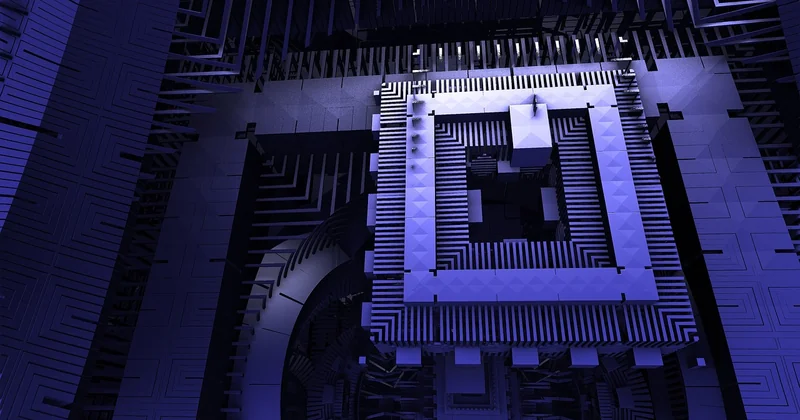
Simulating how a molecule behaves—how a drug candidate binds to a protein, how a battery electrolyte degrades, how a catalyst behaves under heat—is brutally expensive on classical hardware. The cost grows so fast with molecule size that exact simulation quickly becomes impossible. Nature computes these molecules quantum-mechanically, so it makes sense to simulate them on quantum hardware.
Researchers have used early quantum processors to model small molecules and simplified chemical systems, and the results matched what theory predicted. That's a genuine result. But it's a proof that the approach works on tiny systems, not evidence you'll order a quantum-designed drug next year.
Which brings me to an important warning. I've watched two companies in the last few years put "quantum-powered" on their marketing pages when what they'd actually done was run a slightly unusual classical optimisation. That's not fraud, exactly. It's just that "quantum-inspired" sells better than "we used a solver on a GPU." Be sceptical of any claim that doesn't name the hardware.
How the hardware choices compare
| Approach | What it's good at | Where it struggles |
|---|---|---|
| Superconducting circuits | Fast gate operations, well-developed fabrication | Needs extreme cooling, short coherence times |
| Trapped ions | High fidelity, long coherence | Slower gates, harder to scale up |
| Photonic | Works at room temperature, easy networking | Losses in transmission, tough two-qubit gates |
| Neutral atoms | Scales to many qubits in one array | Younger technology, less mature tooling |
None of these has clearly won. Anyone telling you otherwise is selling something.
What is quantum computing used for today?
Honestly? Mostly research. Some optimisation trials, some chemistry experiments, a lot of benchmarking. Cloud providers let you rent time on real quantum processors, which is genuinely useful for learning, though the queue times can test your patience.
The areas where quantum advantage is most plausible:
- Chemistry and materials discovery — the strongest candidate, because the problem is natively quantum.
- Certain optimisation problems where the search space is enormous and the structure is favourable.
- Cryptanalysis — breaking the encryption schemes currently protecting most internet traffic.
And the areas where quantum is often oversold: general business analytics, ordinary machine learning, and anything marketed as "quantum AI" without a specific algorithm named. Most day-to-day computing problems are already well handled by classical machines, and a quantum computer would just be a slower, colder, more expensive way to get the same answer.
Who invented quantum computing?
Physicist Richard Feynman is the name most often attached to the founding idea. In a 1982 talk, he argued that simulating quantum systems on classical computers was fundamentally inefficient, and that you'd need quantum hardware to do it properly. That framing—nature computes quantum mechanically, so use quantum machines—is still the strongest argument for building these things.
Others built on it. David Deutsch formalised the idea of a universal quantum computer in the mid-1980s. Peter Shor's 1994 algorithm showed that a quantum machine could factor large numbers exponentially faster than the best known classical method, which is what turned a physics curiosity into a national security concern. And Lov Grover's search algorithm gave quantum computing a second practical tool.
One thing worth noting: nobody "invented" quantum computing in the way Alexander Graham Bell invented the telephone. It emerged from decades of theoretical physics, and the engineering is still being figured out in real time.
Why this matters more than the hype
Two things are true at once. Quantum computing is genuinely one of the most significant technical undertakings of this century. And almost everything you read about it in a press release is inflated.
What I'd want you to take away is narrower and more useful: the technology will not replace your computer, it will sit beside it as a specialised accelerator for a short list of problems. The encryption migration is the one consequence that touches nearly everyone, and it's already underway. The chemistry payoff is the one that could actually change medicine.
And if someone tells you a quantum computer just solved something a classical machine couldn't—ask which machine, which algorithm, and how many physical qubits were involved. That question filters out about ninety percent of the noise.
What I keep coming back to is the coin. Still spinning, still unresolved, collapsing only when someone finally measures it. That's not a bad metaphor for where the field itself sits right now: everyone knows the answer is in there somewhere, and nobody can say yet what it will land on.